 AnyLot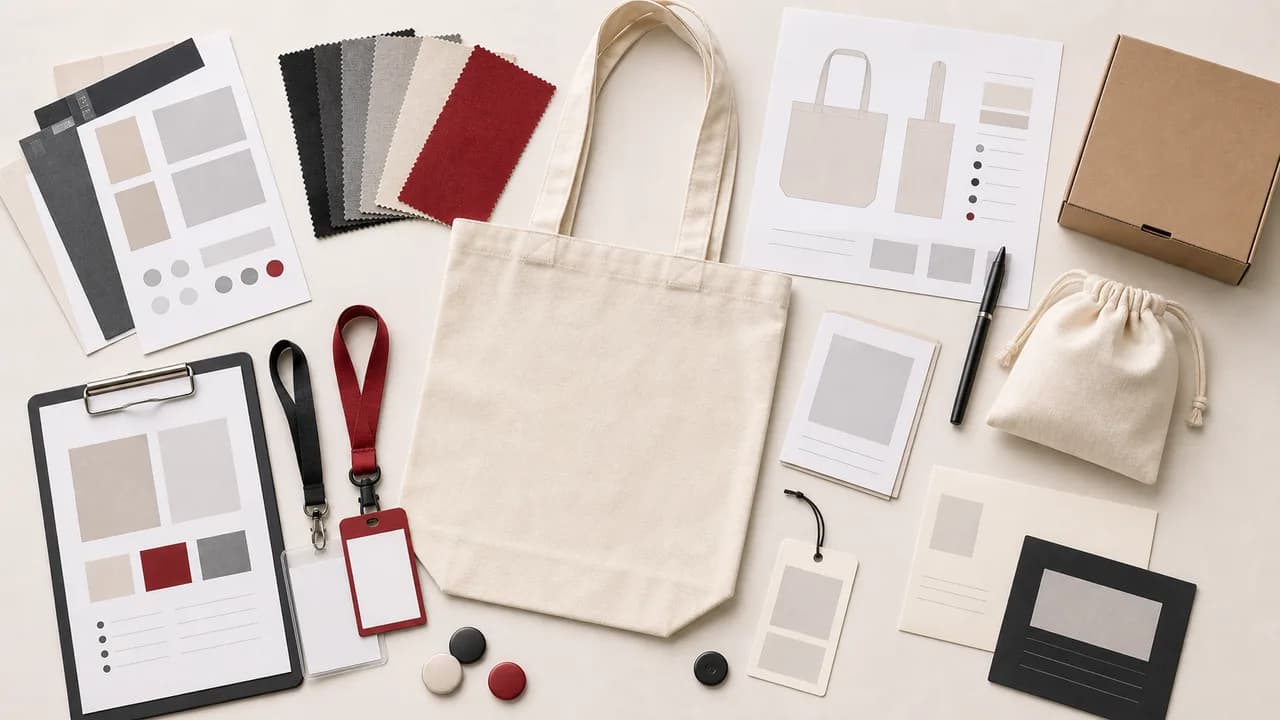
Key takeaways
- Design novelty specs around both giveaway experience and reuse
- Separate body MOQ, print MOQ, setup fees, and shipping in quotes
- For events, confirm timing, packing, and direct delivery early
Find OEM suppliers for these conditions
Define the event giveaway conditions
This case assumes a small-batch logo tote bag for a trade show novelty. The goal is to help visitors carry documents and keep the brand visible outside the venue.
Start by defining expected recipients, document volume, desired reuse period, budget, and delivery date. A simple document bag and a daily-use brand item require different priorities for fabric weight, sewing, handles, and print quality.
For trade shows, plan backward from the setup date: sample review, production, inspection, individual packing, and venue delivery. Since event dates are fixed, build in buffer to avoid delivery delays.
For overseas teams ordering from Japan OEM suppliers, event date, venue delivery rules, and customs timing should be treated as core specifications. A low-cost novelty has little value if it arrives after booth setup or cannot be accepted by the venue.
- Expected quantity
- Weight of documents
- Desired reuse period
- Venue delivery date
Design material, size, and print area
For tote bags, define material, fabric weight, size, gusset, handle length, and print area. Lightweight nonwoven or cotton bags are easy for giveaways, while heavy canvas is more reusable but tends to increase unit cost and shipping weight.
If the bag carries trade show materials, check whether A4 documents fit, whether it can handle catalog weight, and whether it can be carried on the shoulder. Short handles can be inconvenient, and no gusset may make documents or samples hard to fit.
For printing, decide logo size, position, color count, and one-side or two-side printing. Large solid areas and small text may blur or fade depending on material, so confirm with a sample or proof.
If the tote will be used by visitors walking around a venue, usability matters as much as logo visibility. Handle length, opening width, fabric stiffness, and folding size affect whether people continue carrying the bag after receiving it.
- Material and fabric weight
- A4 fit and gusset
- Handle length
- Print size, colors, and position
Compare MOQ, setup fees, and reorder terms
For tote bag novelties, the MOQ for the bag body and the MOQ for printing may differ. Printing on stock bags is easier at low quantity, while original size or custom material usually raises body MOQ.
In the quote, separate bag cost, print cost, screen or setup fee, proofing, individual packing, and shipping. The first order may look expensive because setup fees are included, but reorders may not need the same setup fee.
Request quantity tiers such as 100, 300, and 500 units to balance event distribution and spare inventory. If remaining stock can be used for ecommerce inserts or store giveaways, include that in the quantity decision.
When comparing small-batch OEM quotes, calculate cost per distributed unit rather than only cost per produced unit. Extra stock, shipping cartons, event handling fees, and unused inventory after the event can change the real economics of a novelty project.
- Body MOQ and print MOQ
- Setup and proofing fees
- Individual packing and shipping
- Setup fees for reorder
Sample and inspection points
In the sample, check logo position, print color, bleeding, handle sewing, bottom strength, fabric transparency, odor, wrinkles, and folding. If the bag will carry event documents, test it with a realistic weight.
Print color can differ between screen, paper color guides, and fabric. If brand color is important, discuss color standards such as DIC or Pantone, acceptable tolerance, and sample confirmation method.
For inspection, define acceptable limits for print fading, placement shift, stains, missed sewing, thread trimming, and size variance. Even as a novelty, rough finish affects brand perception because the brand name is printed on it.
For logo novelties, request a photo proof or pre-production sample showing the actual print size and position on the selected bag body. A digital mockup may look balanced, but the final impression changes with fabric texture, seams, gusset, and handle placement.
- Logo position and print color
- Handle and bottom strength
- Stains, odor, and wrinkles
- Thread trimming and size variance
Supplier comparison and ordering decision
When comparing tote bag suppliers, look beyond price. Check stock bag availability, print method, sampling support, short lead time support, individual packing, direct venue delivery, and reorder ease. For event projects, accurate timing responses are especially important.
For the first order, communicate required quantity plus spare units, delivery location, packing unit, and venue delivery rules. If shipping directly to a venue or warehouse, confirm shipping label wording, delivery date designation, and split delivery.
On AnyLot, compare suppliers strong in bags, fabric goods, and novelties so you can discuss specifications that fit the use case, not only printing on a generic item.
If measuring post-event impact, you can also plan QR cards, visitor surveys, or social posting prompts. However, when delivery timing is the top priority, avoid overcomplicating the promotion and choose specifications that can arrive reliably.
If the tote bag will support lead generation, coordinate production planning with the campaign operation. QR cards, inserts, coupon codes, and packing order should be decided early because adding them after bag production may require repacking and delay delivery.
FAQ
What MOQ is typical for novelty tote bags?
Printing on stock bags may be possible at lower quantities. Original size, custom material, or special processing usually raises MOQ, so confirm body and print minimums separately.
What matters most for trade show tote bags?
Prioritize delivery timing, A4 document fit, handle length, logo visibility, and packing that is easy to bring into the venue. For reuse, also prioritize fabric weight and sewing quality.
Are setup fees charged every time?
It depends on the supplier and storage period. Some charge only first time, some waive it for reorders within a period, and some charge again when artwork changes.
How should spare inventory be planned?
If spare bags can be used for ecommerce inserts, store giveaways, recruiting events, or customer gifts, ordering extra may make sense. Otherwise, keep quantity close to required units plus buffer.

Written by
AnyLot Editorial Team
We organize practical information on OEM sourcing, supplier comparison, and first production runs so brand teams can review key conditions with confidence.
Related articles
How to Find Small-Batch OEM Partners: Compare MOQ, Quotes, and Production Terms
For first production runs and test launches, learn how to compare small-batch OEM partners by MOQ, sample cost, quote terms, reorder terms, production readiness, and risk points.
ReadWhat Is MOQ? How to Judge Minimum Order Quantity and Unit Cost in OEM
Understand MOQ in OEM production, including color, size, and container units, its relationship with unit cost, quote checks, negotiation points, comparison methods, and common first-order mistakes.
ReadOEM Sample Request Flow: Preparation, Review Points, and Production Decision Steps
Learn what to prepare before requesting an OEM sample, what to include in the brief, how to review quality, give revisions, judge resamples, decide on production, and record key terms.
Read